Don't miss our upcoming events! Info here!
These Lands Are For Everyone: A Day in the Field with NYS DEC Region 3
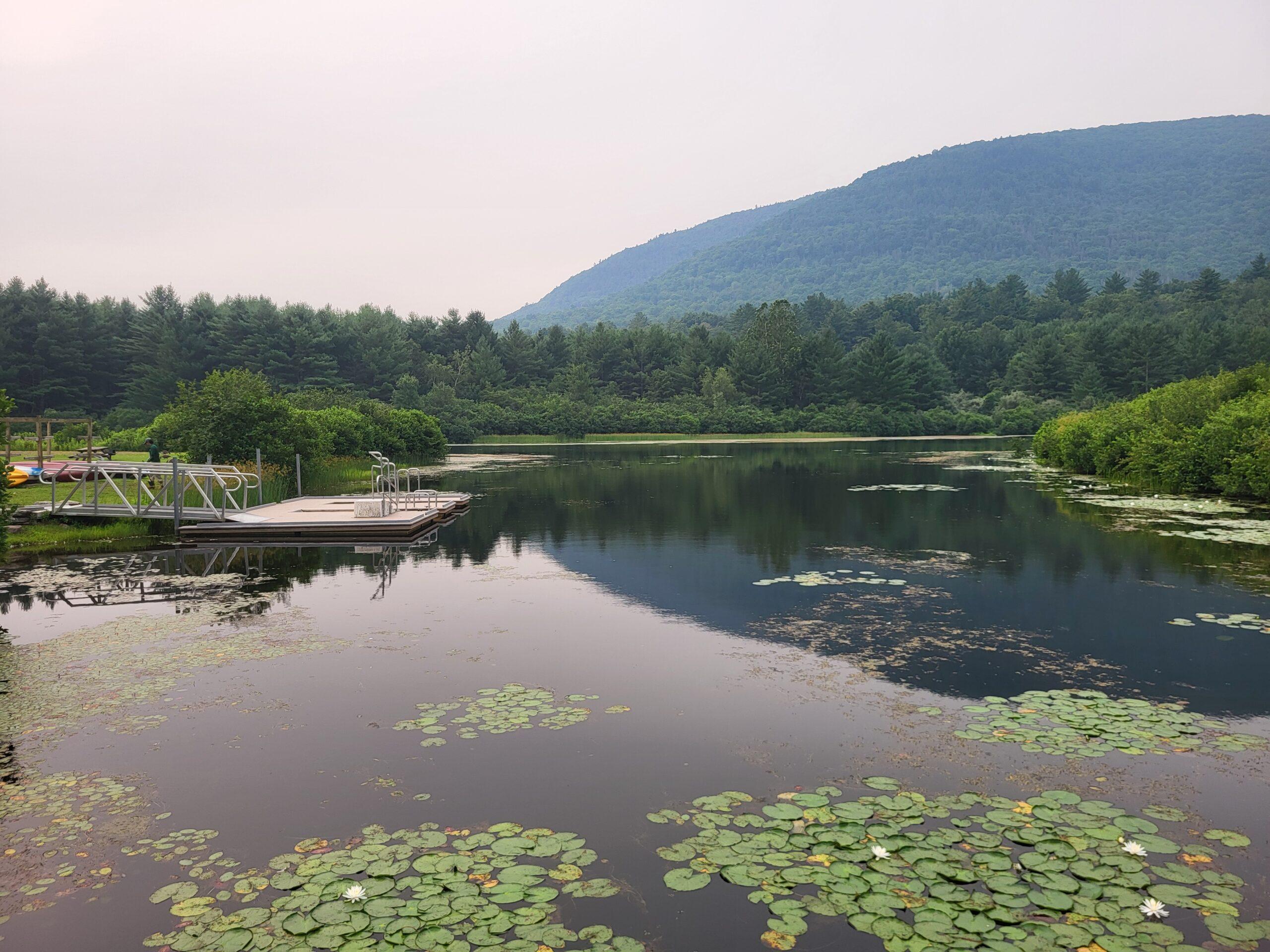
What a beautiful place to spend a day building inclusion!
We had the joy of joining NYS DEC Region 3 for an Inclusivity & Accessibility Training Workshop at the Kenneth L. Wilson Campground in Mt Tremper, NY — a day that moved from the classroom out into the field and invited us all to visualize how “inclusion” can be built into the campground experience
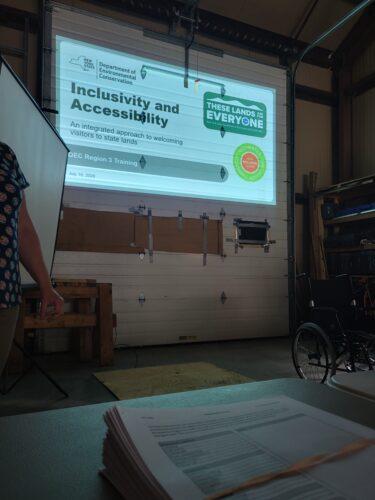
Starting in the classroom — grounding the day in what it really means to welcome every visitor to New York’s state lands.
Starting with the “why”
We opened indoors, talking through what it takes to welcome visitors of all abilities to public lands — not as a one-time fix, but as a way of operating every day the gates are open. We love getting into this level of systems-change work: giving the people who manage these spaces the lens, the language, and the confidence to see access as part of the everyday experience they create for every guest.
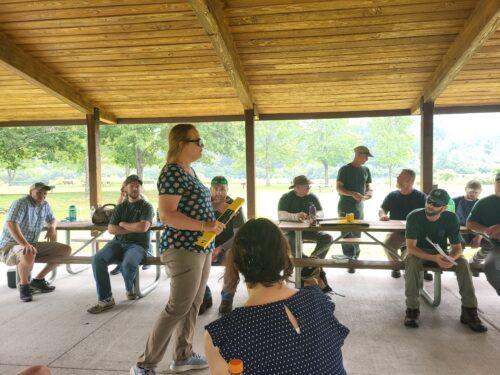
Regrouping under the pavilion between field sessions to compare notes and questions.
Then into the field
The best classroom for this workshop was right around the corner at the Kenneth L. Wilson Campground, one of the many campgrounds the DEC manages. Our workgroup headed out to assess the fishing dock, the kayak launch, and the access path that connects the two. New measuring tools recently acquired by the DEC through a grant were put to use immediately as staff learned to assess an already-built amenity and to gauge any discrepancies from original specs.
Staff were encouraged to understand that while the original build or installation of an accessible amenity may have been in compliance with ADA and ABA standards, variances very often occur because of things like
- changes in an amenity due to use over time
- changes in terrain due to weathering/erosion
In addition, DEC staff rotated using a manual wheelchair along all pathways considered “accessible”. Rolling the path gives a much clearer perspective. As the group moved along the path, you could feel how just five to seven years of use and erosion had reshaped the surface — a slope that used to be gentle, a spot where the “firm/stable” ground has worn away and revealed larger chunks of gravel, a stretch that asks a lot more of a person than it did the year it was built. Those are the details that don’t show up until you’re the one making the trip.
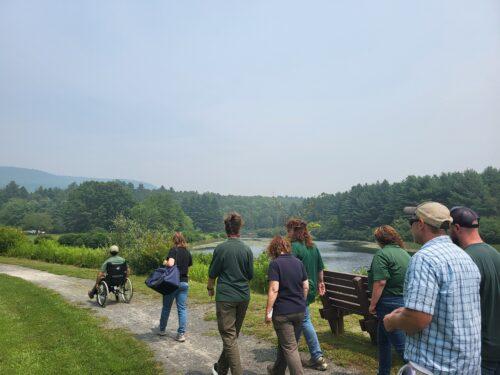
Each team member rotated through a manual wheelchair along the path connecting the fishing dock and kayak launch — feeling firsthand how erosion and use change the journey over time.
Where the barriers hide: the transitions
Boardwalks carry the pathways across the spots where the ground can’t, and the team paid close attention to the transitions — the places where a boardwalk meets the path or shifts from one surface to the next. It’s exactly at those small changes that erosion can quietly turn a smooth connection into a barrier: a lip that’s grown too tall, a gap that’s opened up, an edge that’s dropped. Catch it in a transition, and you catch it before it turns someone around at the water’s edge. What looked at first glance like a benign 2-3 inch lip proved unnavigable to many of us!
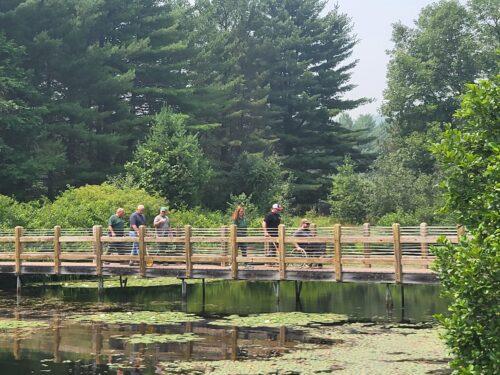
Where boardwalks meet the path, a small change in the transition can become a big barrier — so that’s where we looked closely.
A commitment that spans 5 million acres
Days like this are part of a much bigger picture. NYS DEC has continued to build processes that help manage the accessibility of publicly accessed places across its more than 5 million acres of state lands — and to help visitors find those places, DEC created an interactive Accessible Recreation Destinations Map.
It’s genuinely worth exploring. You can search accessible options for kayak launches, camping, birding, fishing, photography, and more across the state, and plan a trip knowing what’s waiting for you when you arrive.
👉 Explore the map: NYS DEC Accessible Recreation Destinations
Why we do it this way
You can’t assess a space only when it is built or installed. On the day of installation, we’d love to expect that an amenity is in compliance with ADA and ABA standards. But places like campgrounds, parks, playgrounds, trails, and other outdoor experiences need to have assessment built into their annual/semi-annual maintenance schedules. And, to literally figure out what one is looking for, these kinds of hands-on experiential learning workshops help teams see and feel the barriers.
Accessibility stops being an abstract checklist and becomes something they understand in their hands and their shoulders. That understanding is what carries forward long after we’ve packed up: into the next repair, the next design decision, the next visitor who rolls up to that dock and finds the way clear.
Huge thanks to the NYS DEC Region 3 team for the energy, the curiosity, and the commitment to exploring greater accessibility and intentional inclusion of people living with disabilities. RAA has worked in a full Inclusion Partnership with NYS DEC’s Region 8 and always welcomes further exploration to making these lands work for everyone!
This kind of hands-on inclusion work and our work to directly connect people living with disabilities to these kinds of outdoor adventures is supported in part by the REI Cooperative Action Fund — thank you for helping us get offline and get outdoors, together!
Ready to find your own adventure?
If you or someone you love is wondering what’s possible on New York’s public lands, start with DEC’s Accessible Recreation Destinations Map (link is above) — and reach out to RAA’s DirectConnect Resource Guide for handy links, printables, and help connecting to inclusive recreation near you.
Let’s #MakeInclusionHappen in the great outdoors — because #TheseLandsAreForEveryone. 🌿